
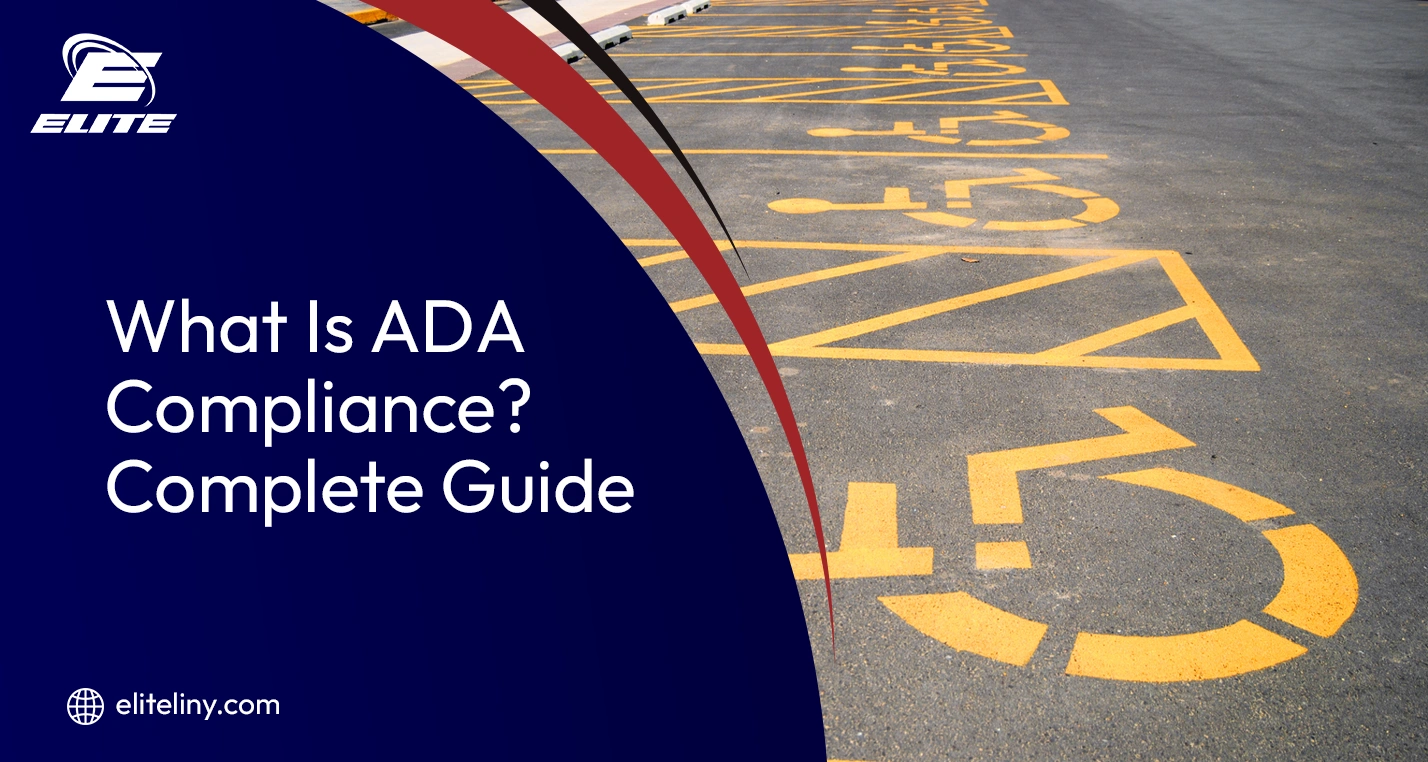
If you’ve ever walked across a parking lot and noticed the bright blue lines, the wide aisles, the lowered curb cuts, and the signs sitting higher than your head, you’ve already seen ADA design in action. Most people recognize the look, but not the rules behind it. So when someone asks what ADA Compliance is, the answer reaches a lot further than “paint the handicap spots and call it a day.” It covers parking, ramps, walkways, entrances, surfaces, and everything a visitor with a disability might interact with from the moment they pull in. Understanding these basics keeps properties safe, legal, and welcoming, and it stops those surprise violations that show up at the worst possible time.
What Is ADA Compliance?
ADA Compliance refers to meeting the standards of the Americans with Disabilities Act. This law requires public and commercial properties to make their spaces usable for people with mobility limitations, visual challenges, hearing impairments, and other disabilities. In practice, this means the environment must be navigable without barriers or unnecessary struggle.
A compliant site includes features like:
- Accessible parking spaces in the correct quantity
- Properly sized access aisles
- Ramps with approved slope and surface texture
- Clear, stable walkways
- Entrances that allow smooth, easy access
- Signage that meets color and height guidelines
- Ongoing maintenance that keeps the site safe
Many businesses pass inspection when a property is new, then drift out of compliance over time due to fading paint, cracked pavement, or missing signs. The ADA views accessibility as continuous, not a one-time achievement.
What Does ADA Compliance Include
To know if a space is truly accessible, you first have to look at what the ADA actually requires.
1. Accessible Parking Layouts
Parking is one of the biggest parts of ADA design. There must be an exact number of accessible stalls based on the total number of spaces on the property. At least one must be a van-accessible space with a wider aisle. The striping must be crisp and easy to see. The access aisle must remain completely open. And signs need to be mounted high enough that even an oversized truck cannot block them from view.
2. Ramps Built to the Right Slope
A ramp that is slightly too steep can turn into a safety hazard. ADA rules specify the rise, run, surface finish, landing size, and handrail requirements. A cracked or uneven ramp can fail inspection even if it technically meets the measurements. Maintenance is just as important as installation.
3. A Smooth, Continuous Path to the Entrance
Once someone parks, they should reach the building without running into obstacles. This means no sudden steps, no potholes, no broken pavement, no cluttered sidewalks, and no excessively sloped sections. The ADA wants that journey to be predictable, stable, and clearly marked.
4. Accessible Entrances That Work for Everyone
Entrances must have doorways wide enough for wheelchairs, minimal thresholds, and the proper clearances. Heavy doors or hardware placed too high can lead to violations. Even a high rug can cause trouble if it disrupts mobility.
5. Proper Signage and Markings
Signs need the correct color contrast, reflectivity, height, and language. Parking signs, restroom signs, exit signs, and room markers all fall under ADA design. An accessible space isn’t legal without the proper sign above it, even if the pavement markings look perfect.
6. Routine Upkeep
A parking lot might start off fully compliant, but time works against it. Paint wears away. Asphalt shifts. Signs lean. Curbs chip. A faded marking can be enough for a violation, and a cracked ramp might be considered unsafe. ADA Compliance requires the site to be maintained, not just installed correctly once.
Why Does ADA Compliance Matter?
Once you know what’s included, the next step is understanding why it all matters.
1. It Protects People Who Need Safe Access
Someone using a wheelchair depends on a flat, stable access aisle. A cane user relies on clear, predictable walkways. A visitor with low vision uses high-contrast lines to navigate. When the site is compliant, these guests move freely without feeling like they’re fighting the property.
2. It Reduces Legal Risk
Fines for ADA violations can get expensive, and lawsuits are even more costly. Most infractions come from simple neglect: faded striping, missing signs, or damaged walkways. Fixing these early prevents headaches later.
3. It Improves Guest Experience and Reputation
A compliant property tells visitors that the business cares about accessibility. Everything feels intentional. Everything works. Guests remember that. And they remember when it isn’t true too.
4. It Saves Money During Property Upgrades
Staying compliant helps avoid major repairs. If a ramp is maintained regularly, you don’t have to rebuild it from scratch. If the striping stays visible, the layout remains enforceable. Preventive work costs far less than emergency reconstruction.
5. It Keeps the Property Ready for Inspections
Cities, tenants, auditors, and even customers may report violations. A property that stays ADA-ready avoids last-minute scrambles or rushed repair jobs.
Conclusion
Once you understand what ADA Compliance is, it becomes obvious how much of a property it truly touches. It isn’t just about one ramp or one painted symbol, it’s the entire route someone takes from the moment they step out of their vehicle to the moment they walk through the door. When any part of that path fades, cracks, shifts, or loses visibility, accessibility drops and compliance goes with it. Staying ahead of those details protects visitors, cuts down legal risk, and keeps the site looking professional instead of neglected. And if you’d rather have an expert walk the property and point out exactly what needs updating, Elite Parking Area Maintenance can inspect, repair, restripe, and bring everything back to ADA-ready condition.