
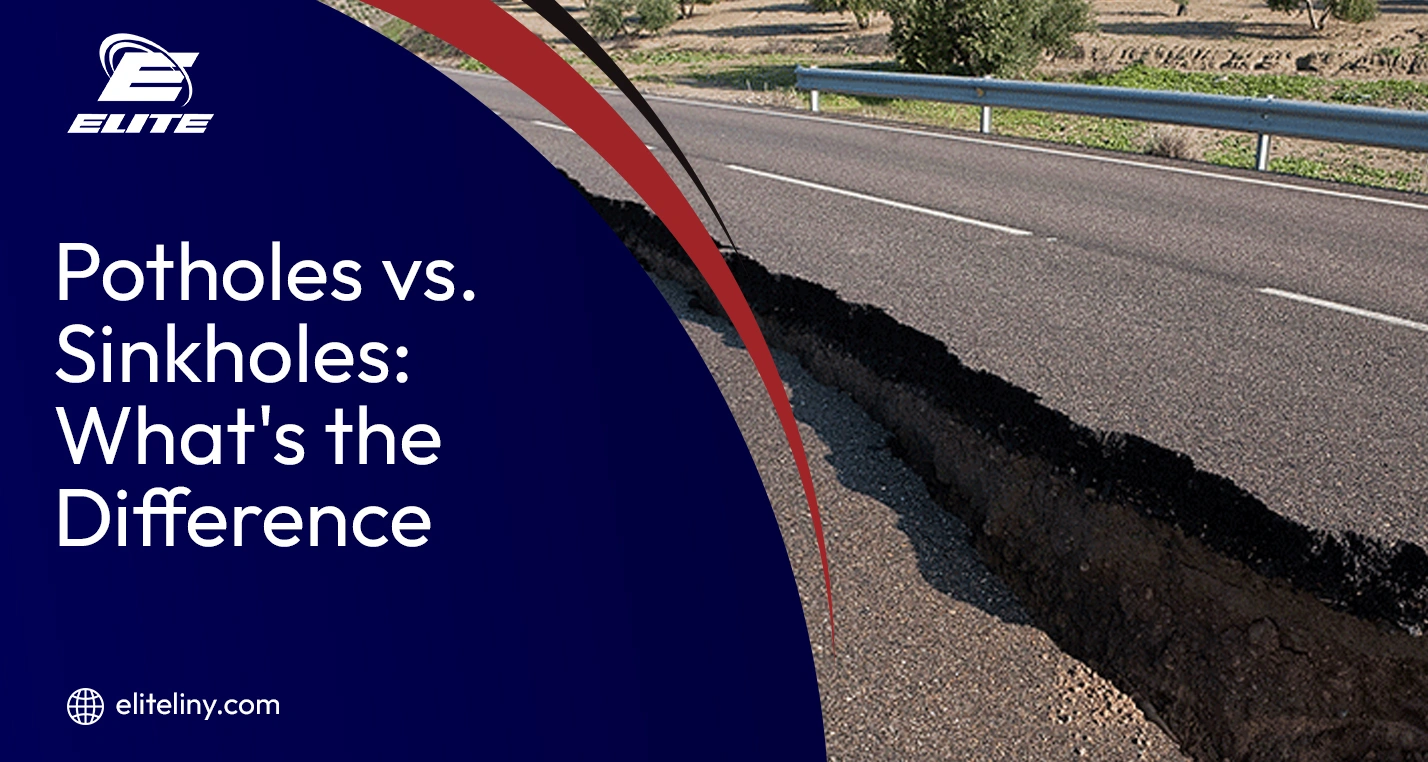
A pothole is a surface-level failure caused by water getting under the pavement and the asphalt breaking apart under vehicle load. A sinkhole is a ground collapse caused by the erosion of material below the surface, sometimes going several feet or more underground. Potholes damage vehicles. Sinkholes can swallow them. Both look like holes in the ground but what’s happening underneath is completely different and so is how each one gets handled.
Core Takeaways
- The pothole vs sinkhole difference comes down to what’s causing the hole. Potholes are a pavement failure. Sinkholes are a ground failure.
- Potholes form at the surface when water weakens the base layer and traffic breaks the asphalt above it. They’re shallow and contained.
- Sinkholes form when material underground erodes or collapses creating a void that the surface eventually falls into. They can be deep, wide and structurally dangerous.
- Potholes are a maintenance issue. Sinkholes are a safety emergency.
- Most holes in a parking lot are potholes. But if the ground feels soft, the hole keeps growing or nearby surfaces are cracking and sinking, get a professional assessment before assuming it’s just a pothole.
What Is a Pothole?
Water gets into cracks in the surface and causes damage to the layer underneath that makes holes. When vehicles drive over the weakened section the asphalt flexes, breaks apart and chunks get dislodged, leaving a hole. Freeze-thaw cycles speed this process up opening cracks every winter. Potholes are most common in high-traffic areas like parking lots and roads. They tend to stay fairly contained and don’t generally grow past the weak section of base right underneath.
What Is a Sinkhole?
Sinkholes begin underground and work their way up. What happens is the ground under the surface erodes, dissolves or shifts and creates a void. Eventually, the surface above falls into the void. Natural sinkholes form when water dissolves rock, such as limestone, from below the surface over time. Man-made sinkholes happen near broken water mains, damaged sewer lines or poorly compacted fill. A leaking pipe erodes surrounding soil, a void forms and the surface drops. In parking lots, man-made causes are actually more common than geological ones.
Pothole vs Sinkhole: Key Differences
If you look at them from above, they may seem similar. Underneath, it’s a whole other story.
How Each One Forms
Potholes are made from the top down. The surface cracks let the water in and weaken the base and the traffic breaks up the surface. Sinkholes develop from the bottom up. Material underground erodes or collapses, creating a void that eventually causes the surface above to collapse.
Size and Depth
The depth of potholes is usually only a few inches to a foot. Damage is restricted to the pavement course and the base underneath. Sinkholes can be much deeper. Some are just a few feet. Some are considerably larger. The surface opening is not necessarily indicative of the size of the void below.
Warning Signs Before They Appear
Usually, potholes give warning signs. Cracking, depression on the surface, and pooling of water in one place. They develop gradually enough that you can often see them coming. Sinkholes can develop with little or no warning. Sometimes there are signs, like doors and windows suddenly sticking, little cracks in nearby structures, or a circular depression in the ground. Sometimes, there are almost no warning signs before the surface drops.
How Fast They Develop
Potholes typically form over months or years. The process behind it is gradual even though the final surface failure seems to be sudden. Sinkholes can develop either very quickly or slowly. A slow sinkhole could take years to reach the surface. A collapse can happen in seconds.
Damage They Cause
Potholes damage vehicles. Tires, rims, suspension components and alignment all take hits from significant potholes. They create slip and trip hazards for pedestrians. For property owners they create liability exposure when vehicles or people are injured. Sinkholes cause structural damage to anything above or near them. Buildings, parking lots, roads and underground utilities are all at risk when a sinkhole forms. A large sinkhole is a genuine safety emergency not just a maintenance problem.
How Does Each One Get Fixed?
Potholes get patched. The damaged asphalt gets removed, the base gets compacted and new asphalt gets laid and compacted. A proper repair holds for years. A bad repair fails within months. Sinkhole repair is more involved. The void underneath needs to be filled and stabilized before anything happens at the surface. Grouting, compaction and sometimes geotechnical assessment are all part of sinkhole remediation. Patching the surface of a sinkhole without addressing the void underneath is dangerous and pointless.
Spot the Difference: Pothole vs Sinkhole
Most holes in a parking lot are potholes but a few surface signs tell you to look more carefully before assuming.
- Pothole edges are irregular and jagged where asphalt has broken away. Sinkhole edges tend to be more circular and defined.
- Tap around the edges of the hole. A hollow sound may indicate a void beneath the surface rather than a simple pavement failure.
- A pothole sits in isolation. A sinkhole often has cracking or subsidence spreading in a wider area around it.
- If the ground around the hole feels soft or unstable underfoot, that’s a sign that something is wrong below the surface.
- If the hole goes deeper than expected or you can’t see the bottom clearly, restrict access and get a professional assessment before anyone goes near it.
Which One Is More Dangerous?
Potholes are a hazard but a manageable one. Vehicles get damaged, people trip and property owners face liability. The fix is straightforward once the repair gets done properly.
Sinkholes are a different category of risk. The danger extends beyond the visible hole to anything above or near the underground void. Buildings, utilities and people on the surface are all at risk when an active sinkhole is present. A large sinkhole can appear with almost no warning and the structural consequences can be severe.
If there is any doubt about what you’re dealing with restrict access immediately and get a professional on site before anyone goes near it.
Conclusion
The pothole vs sinkhole difference matters because the response to each one is completely different. A pothole needs a proper repair. A sinkhole needs a proper assessment before anyone touches it. Both cause damage and both create liability exposure for property owners but the scale of risk and the complexity of the fix are not comparable. If your parking lot has a hole you’re not sure about Elite Parking Area Maintenance can assess and repair pavement damage properly. Get in touch before a small problem becomes a much bigger one.
FAQs
Can a pothole turn into a sinkhole?
Not really. A pothole is a failure of a surface. A sinkhole is a failure under the surface. They develop through different processes. But a pothole left unattended, allowing large amounts of water to seep in over time, can cause base erosion, which in rare cases creates conditions for more serious ground problems, depending on what is beneath.
How do I know if I have a sinkhole or just a deep pothole?
Check the edges, poke around the hole. It may be more than a pothole if it has rounded edges, soft ground around it, sounds hollow when you tap the area and the hole is deeper than you’d expect. If you have any of these signs, seek a professional evaluation.
Who is responsible for fixing a pothole in a parking lot?
The owner of a private parking lot is responsible for the maintenance of the surface. If a pothole you knew about injures someone or something, it is the property owner’s responsibility. The practical way to deal with that risk is regular inspection and prompt repair.